Exclusivity by the Numbers: How to Tell Whether a Luxury Island Resort Is Truly Remote or Simply Performing Privacy
There is a particular irony embedded in the modern luxury island experience. A traveler books months in advance, pays a substantial premium, and arrives by seaplane or private transfer — only to find that the resort's infinity pool is shared with forty other guests who received precisely the same marketing promise of an 'intimate sanctuary.' The brochure was not technically dishonest. The resort is, in fact, on an island. The water is, indeed, turquoise. But the solitude? That was always a carefully constructed illusion.
For American travelers accustomed to paying top dollar for top-tier experiences, understanding how luxury island resorts engineer the perception of exclusivity — without necessarily delivering its substance — has become an essential pre-travel discipline.
The Vocabulary of Manufactured Intimacy
Begin with language. Resort marketing teams are extraordinarily skilled at deploying terms that imply seclusion without legally committing to it. Phrases such as 'secluded setting,' 'intimate atmosphere,' and 'private beach access' are constructed with deliberate ambiguity. 'Private beach access' means guests of that resort may use that beach — not that the beach is inaccessible to others. 'Intimate atmosphere' is an aesthetic judgment, not a measurement of occupancy.
The most revealing metric a resort rarely publishes voluntarily is its total room or villa count relative to the island's land area. A property with 80 villas spread across a small island may describe itself as exclusive while operating at densities that would make a mid-range Caribbean all-inclusive blush. Genuine sanctuaries — the kind that travelers with serious privacy requirements seek — typically maintain ratios of no more than one key per two to three acres of usable land. When evaluating a prospective booking, request this figure directly. A hesitant or evasive response from a reservations agent is itself informative.
Seasonal Crowd Dynamics and the Peak-Season Trap
Even resorts that genuinely limit their room count can feel overcrowded under the wrong conditions. The luxury travel calendar has grown increasingly compressed, with peak demand now clustering around predictable American holiday windows: the period between Christmas and New Year's, the weeks surrounding Presidents' Day, and the spring break corridor from mid-March through mid-April. During these intervals, even properties that operate at a fraction of capacity the remainder of the year fill every available villa.
Seasoned travelers understand that the optimal window for genuine island privacy often falls in the shoulder seasons — late April through early June, and mid-September through mid-November — when occupancy drops, rates frequently soften, and the resort staff-to-guest ratio shifts dramatically in the traveler's favor. A property that feels crowded in February may offer something approaching genuine solitude in October.
It is worth noting, however, that some island destinations have legitimate shoulder-season concerns: cyclone exposure in the Indian Ocean, jellyfish migration patterns in Southeast Asia, or reduced flight connectivity to remote Pacific atolls. A knowledgeable travel advisor can distinguish between shoulder seasons that offer a genuine value opportunity and those that carry meaningful logistical or environmental trade-offs.
The Satellite View Test and Other Due-Diligence Tools
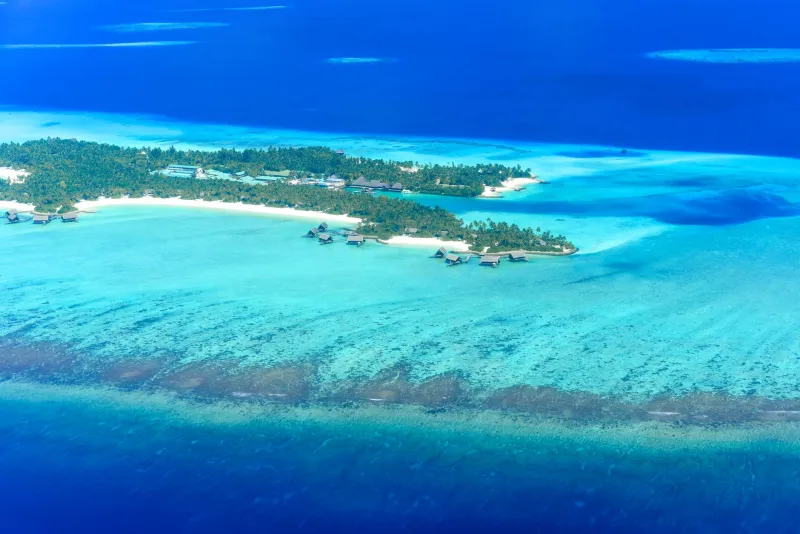
One of the most underutilized research tools available to any traveler planning a luxury island escape costs nothing: satellite imagery. Services such as Google Earth allow prospective guests to examine the actual footprint of a resort, the proximity of neighboring properties, and the realistic scale of the beach or lagoon that marketing photography tends to render expansive through careful lens selection and strategic framing.
A beach that appears vast and deserted in a resort's imagery may, on satellite inspection, reveal itself to be a narrow strip shared by multiple properties. Conversely, some resorts that market themselves modestly occupy genuinely extraordinary natural settings that the photography undersells.
Beyond satellite review, travel forums frequented by experienced luxury travelers — rather than general review platforms susceptible to managed feedback — often contain candid accounts of occupancy realities, noise levels, and the degree to which neighboring guests intrude on the sense of privacy. These firsthand accounts are invaluable precisely because they are not filtered through a marketing department.
What the Booking Pattern Reveals
Resorts that are genuinely difficult to book — those with waitlists measured in months and a genuine scarcity of available dates — are typically operating at low enough capacity that their exclusivity claims carry real weight. Conversely, a property that can accommodate a reservation made three weeks in advance during high season, at the published rack rate, is almost certainly not operating at the occupancy constraints its marketing implies.
Ask your travel advisor or the property's reservations team directly: what is the average occupancy rate during your intended travel period? What is the maximum number of guests the property can accommodate simultaneously? These are reasonable questions that any reputable luxury property should answer with transparency. A property that deflects or declines to provide specific figures has, in effect, answered the question.
The Infrastructure Indicator
The physical infrastructure of an island resort communicates its true character more honestly than any copywriter can. A property with multiple restaurants, a large spa complex, a full-service dive center, a kids' club, and multiple pool areas is not designed for intimate seclusion — it is designed to service volume. These amenities require substantial guest throughput to justify their operational costs.
Truly remote sanctuaries, by contrast, often feature simpler, more curated programming: a single exceptional dining experience, a small wellness facility, perhaps one or two water sports options. The absence of extensive amenity infrastructure is not a deficiency — it is frequently a signal that the property's economic model does not depend on filling every room every night.
The Honest Conversation With Your Travel Advisor
For American travelers investing significant resources in a luxury island escape, the most effective safeguard against the exclusivity paradox is a frank conversation with a travel advisor who specializes in this category and has visited the properties they recommend. Ask them directly: have you been to this resort? During what season? How many other guests were present? What did the beach look like at midday?
Advisors who have not personally visited a property — and who rely solely on resort-provided materials and familiarization trip summaries — may be unknowingly transmitting marketing claims rather than operational realities. The distinction matters enormously when the goal is genuine seclusion.
Redefining the Standard for True Seclusion
The most discerning island travelers have largely moved beyond the traditional resort model altogether, toward private island rentals, owner-operated boutique properties with strictly limited keys, and destinations that remain genuinely difficult to reach. These options are not without their own complications — logistical complexity, higher absolute cost, and reduced service infrastructure among them — but they represent the clearest path to an escape that delivers on the promise of true privacy.
The island experience that most American luxury travelers are seeking — genuine remoteness, unhurried days, the sensation of having claimed a corner of the world entirely for themselves — does exist. It simply requires knowing how to look past the language of exclusivity toward the operational realities that determine whether a resort can actually deliver what it promises. The difference between a genuinely private island escape and a beautifully staged simulation of one is rarely visible in the photography. It is, however, entirely legible to a traveler who knows what questions to ask.